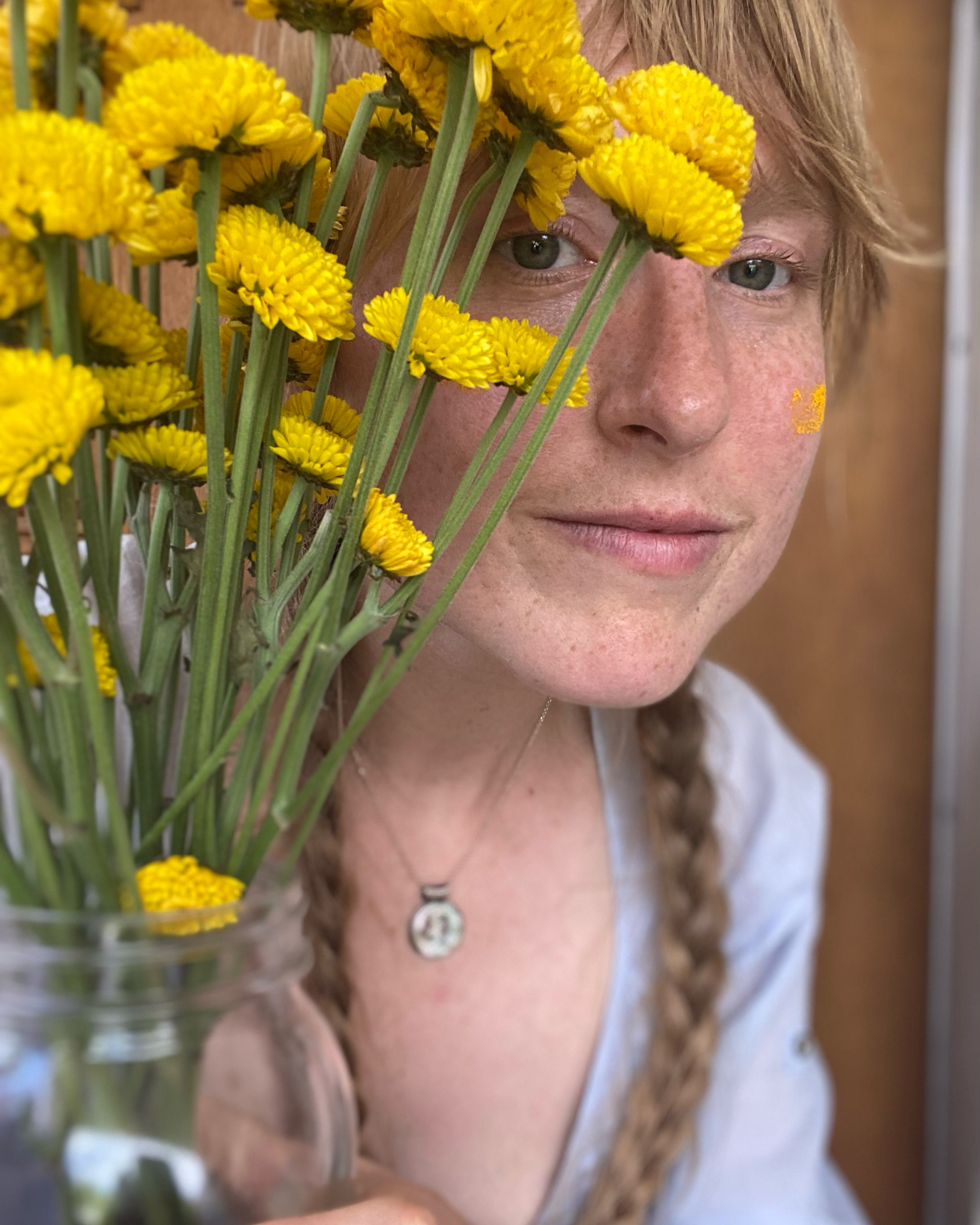
Sarah (sjörå) was raised by a flock of gentle beings: two musicians, the Wasatch Mountains, the Wind Rivers, and Great Salt Lake. She comes from five generations of Mormon stock and is a daughter of the land. Sarah's home is with traditional Shoshone territories and mountains in Utah, though she has also lived and loved in Kenya and New Zealand and is partial to the beings of the Salish Sea and Ecuador — two places she pilgrims to regularly. Her people's roots are in Celtic lands (especially the Scottish Highlands), Scandinavia, and England.
Sarah's life is given to Earth, and she takes her directives from more-than-human teachers. She is a poet, performer, & multidisciplinary artist who works in embedded conversation with the animate beings around her. Drawing on experience in music, movement, writing, listening to the land, and Earth-based healing and activism, her process has ears that prick to the smallest glints of the sentient world. Her work responds to and collaborates with these voices, seeking to entangle humans with the sacred as it is held, danced, and breathed by the beings around us.
Sarah is currently a MOTH Fellow with NYU's More-than-Human Life Fellowship, working on a poetic project with a sacred Ecuadorian cloud forest. She regularly facilitates workshops and meditation groups dreaming toward the sentient world. She'll soon work as a nature writer-in-residence, living in the crook of the bluest river she knows, and was Artist-in-Residence for Sitka Center for Art and Ecology's Winter 2024-2025 season, writing and singing inside the shimmering old breath of a coastal sitka forest.
Sarah's publications include poetry in national reviews The American Journal of Poetry, Calyx Journal, Sugar House Review, and the eco-literary magazine The Hopper; essays exploring Mormon multispecies kindreds; and a dance-poetry film for Great Salt Lake. Sarah's eco-poetry is forthcoming in the anthology A Literary Field Guide to the Rocky Mountains and Western Humanities Review. Her poem "gristle hum," written for Great Salt Lake, was the winner of the 2026 Mountain West Writers' Contest for Poetry.
Sarah earned her Master's degree in socio-ecology in 2024, with research on multispecies justice in the Intermountain West and Mormon settler relationships with ecologies. She worked both as part of a Shoshone project restoring the site of the Bear River Massacre and with downstream efforts to save Great Salt Lake. During her time there, she was awarded USU's 2024 Advocacy Student of the Year in Sustainability for her multispecies justice work for Great Salt Lake. She is currently pursuing an Environmental Sociology PhD continuing her research on Mormon environmentalisms, multispecies justice, and animism in the Great Salt Lake watershed. Her recent academic work is published in People & Nature, and she has a book chapter forthcoming in the Oxford Handbook of Multispecies Justice.
Recent performances and projects include performances and facilitation at international gatherings for the more-than-human world; the Indigenous offering ceremony for Great Salt Lake; a TEDx performance piece; a Great Salt Lake art and poetry exhibit; protest performance projects; and a show of collaborative ecological works. Sarah regularly offers Earth connection and embodiment offerings; multispecies sentience & justice performances, research, and organizing; and various ritual activist, writing, and performance art efforts for and with Great Salt Lake and Los Cedros. For her activist work, she received the Bridgerland Audubon 2024 Jack Greene Youth Conservation Leadership Award.
Sarah serves as a founding board member for two non-profits: 1) Bichu-Nanewe (Return of the People), which empowers Native Cultural Resurgence, uplifts Ecological Tribal Knowledge, and works for Tribal Sovereignty in the western U.S.; and 2) Ecuador's Los Cedros (The Cedars) Fund, a group supporting the conservation of one of the most biodiverse and mysterious forests in the world.
Sarah's primary teachers, influences, and mentors include a council of apple trees, Great Salt Lake, a dog called Magpie, Los Cedros cloud forest, the Winds, Katriona Wilder Ilsedóttir, wild yarrow, mycelia, the poet Kabir, Alex Baldwin, rainforest polillas, David Abram, bioluminescent waters, Kirsten Vinyeta, hermit thrush, two rivers and a stream near her home, Robert Macfarlane, orb weaver, phalarope, Darren Parry, grebe, jumping spider, Danielle Celermajer, skunk, hare, and Snake in her many shapes.
sjörå eun woodbury
òran na smeòraich